
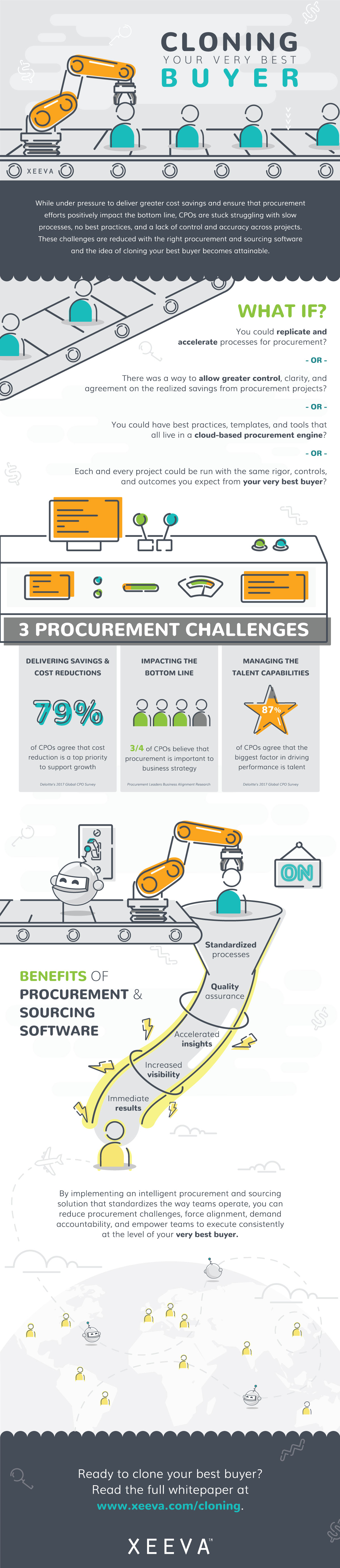
Have you ever wanted to clone your best buyer – essentially having an assembly line that could replicate what makes that buyer amazing and being able to watch as your procurement process improves with best practices, tools, and streamlined processes in place?

In this helpful infographic, you’ll see how your organization could benefit from implementing an AI-powered procurement and sourcing software to tackle procurement challenges and get immediate results. Check out the fun infographic to find out what goes into cloning your very best buyer so you can have clarity and control over projects, greater cost savings, and a business strategy that productively impacts your bottom line.
Whitepaper

Want to see more?

Explore our other resources


MADISON HEIGHTS, MI, December 3, 2019 – Xeeva, Inc., a global provider of specialized AI procurement software, today announced that it was highlighted on CIO Bulletin’s 2019 list of the “30 Fastest Growing Companies to Watch”. CIO Bulletin aims to provide its readers with IT awareness and management skills in order to shape corporate strategies and achieve corporate goals. The annual listing of the 30 fastest growing companies is comprised of innovative companies that are creating...

MADISON HEIGHTS, MI, November 16, 2018 – Xeeva, Inc., a global provider of AI-powered procurement and sourcing software, announced today that it won the runner-up award for “Outstanding Solution Provider” at the 2018 ISM CPO Forum Awards in India for the second year in a row. Focused on recognizing procurement excellence, this was the sixth annual CPO Forum Awards held by ISM. This year’s two-day conference, held in Mumbai, had the theme of the digital...

In contrast to direct procurement, indirect spend includes everything that goes into running a business that isn’t directly tied to the end product, such as maintenance, repairs, and operations (MRO), marketing, facilities, consumables, fleet, freight, travel and IT. Although it can make up as much as 50% of a company’s total purchases, it doesn’t often get the attention it should. The problem with ignoring indirect spend, however, is that you could be missing out on...